For years, project planning followed the same familiar pattern.
Managers gathered tasks, estimated timelines, assigned specialists, built Gantt charts, and hoped reality would stay reasonably close to the original roadmap.
Sometimes that approach worked surprisingly well.
However, as projects became more dynamic, distributed, and interconnected, the gap between “the plan” and actual execution started growing faster every year.
By 2025–2026, many organizations across software development, manufacturing, construction, consulting, and professional services reached the same conclusion:
The problem was no longer poor project managers.
The real problem was that manual planning itself stopped scaling.
We’ve seen this pattern repeatedly across industries.
At first glance, a project plan may look accurate on the day it is created. However, dependencies often begin shifting within days. A few weeks later, managers find themselves constantly rebuilding schedules, reallocating specialists, and explaining why timelines suddenly changed.
Closer to the deadline, teams usually enter firefighting mode.
At that point, project management often turns into continuous damage control rather than structured execution.
Modern projects simply evolve too fast for static planning approaches:
requirements change during execution,
priorities shift weekly,
teams work across multiple parallel initiatives,
contractors move deadlines,
key specialists become bottlenecks,
business expectations change in real time,
dependencies constantly expand across departments and systems.
Because of this, traditional planning increasingly behaves like a static snapshot instead of a living operational system.
That shift is exactly why AI-driven project planning started gaining serious attention.
Why Deadline Prediction Became a Critical Business Problem
When a project slips by one week, the real impact is rarely limited to seven days.
In manufacturing, delays can affect the entire supply chain. In construction, they may trigger equipment downtime, contractor idle time, and financial penalties. Meanwhile, SaaS companies can miss critical market opportunities simply because a release arrived too late.
Marketing campaigns often lose effectiveness when launches happen after peak demand has already passed. In consulting, client trust usually erodes long before a project officially fails.
Still, the most expensive problem is rarely the delay itself.
The real cost comes from discovering the problem too late.
In practice, most project failures begin with relatively small operational signals:
one overloaded specialist,
underestimated work volume,
hidden dependencies,
delayed approvals,
parallel initiatives competing for the same people,
tasks remaining “almost complete” for too long,
resource conflicts nobody noticed early enough.
Traditional planning systems struggle to surface these signals in time.
The information technically exists, but it usually gets buried inside spreadsheets, dashboards, disconnected task trackers, and endless communication threads.
As a result, managers often discover execution risks only after timelines have already started collapsing.
Why Traditional Project Planning Breaks Down
Classic planning methodologies still work reasonably well in stable environments.
The problem is that modern projects are rarely stable anymore.
Most traditional planning systems rely heavily on manual assumptions, optimistic estimates, and periodic updates.
Then reality intervenes.
A developer gets sick.
A supplier delays delivery.
A client changes scope mid-project.
An urgent task suddenly appears.
Meanwhile, a senior engineer gets pulled into another initiative.
At that moment, even a carefully prepared project plan can begin collapsing surprisingly fast.
In many organizations, this is where proactive project management quietly turns into reactive survival mode.
Managers spend more time repairing schedules than actually controlling execution.
Over time, planning itself becomes exhausting.
Instead of managing progress strategically, teams constantly react to new operational disruptions.
We’ve repeatedly seen organizations where managers maintain multiple versions of the “real” schedule simultaneously:
one version in project management software,
another inside spreadsheets,
a third inside chat discussions,
and the actual operational reality existing only in people’s heads.
Naturally, this creates enormous visibility problems.
The larger and more interconnected the organization becomes, the harder manual coordination gets.
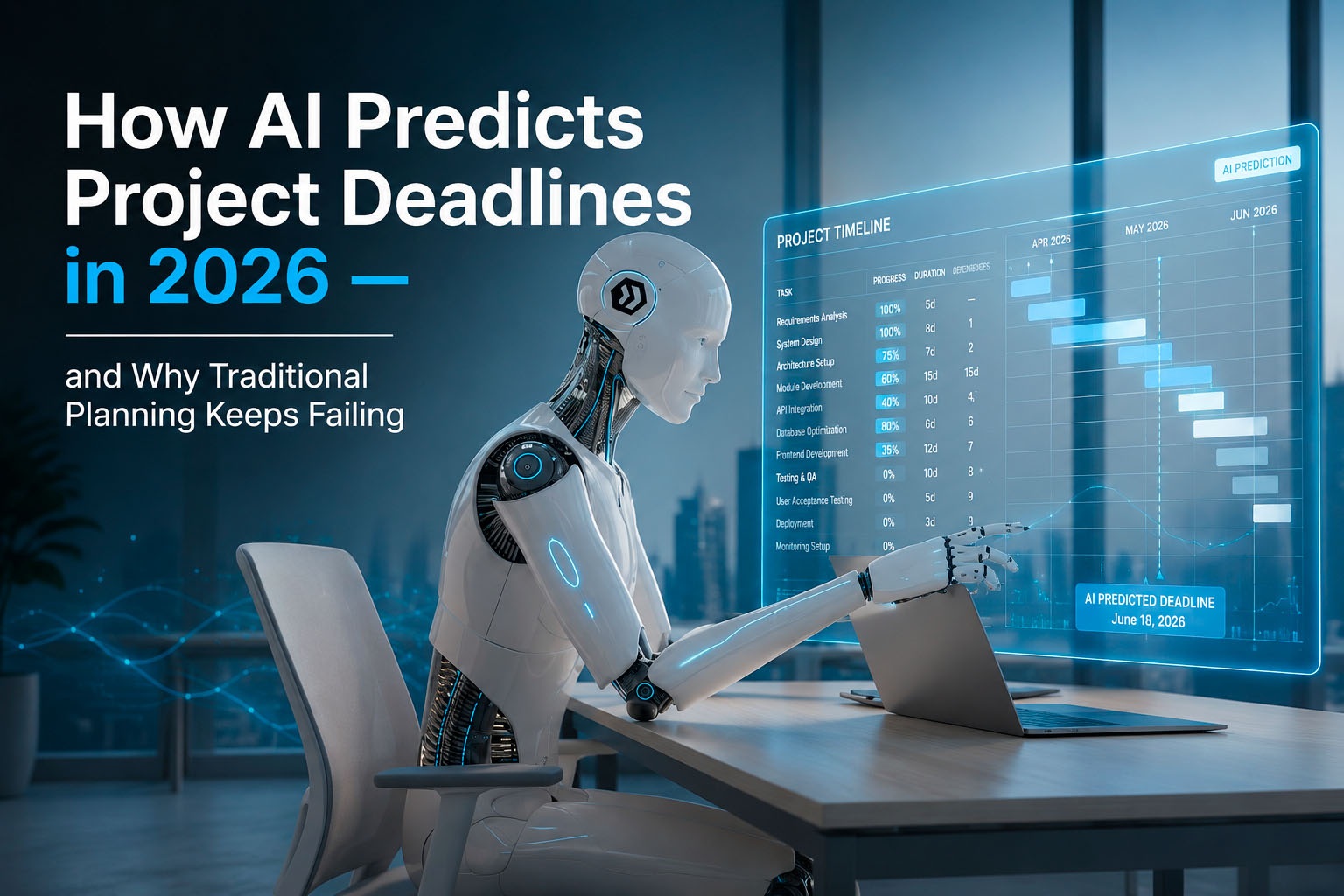
How AI-Based Deadline Prediction Actually Works
Despite the hype around artificial intelligence, effective AI planning systems are not magic.
They do not “predict the future.”
Instead, they continuously analyze operational patterns that humans struggle to track manually at scale.
Modern AI planning systems evaluate:
historical project execution,
actual team velocity,
workload distribution,
specialist availability,
task dependencies,
recurring bottlenecks,
approval delays,
cross-project conflicts,
historical execution behavior,
workload concentration risks,
recurring delay patterns.
Most importantly, AI systems recalculate forecasts continuously.
Not once per quarter.
Not after weekly meetings.
And not only when someone manually updates the roadmap.
Instead, the forecast evolves every time the project changes.
That shift fundamentally changes how organizations approach planning.
Rather than treating planning as a periodic administrative process, companies begin managing execution dynamically.
What AI Systems Notice That Humans Often Miss
One interesting pattern appears after several months of accumulated operational data.
The system starts identifying behaviors that are extremely difficult to detect manually.
For example:
certain task types consistently exceed estimates,
one approval stage slows down every release cycle,
overloaded specialists silently reduce throughput,
specific integrations repeatedly create downstream delays,
some departments systematically underestimate work complexity,
parallel projects compete for the same critical experts.
In many cases, managers initially believe the primary risk is technological complexity.
In reality, the bigger issue is often resource concentration around a very small number of people.
For instance, in one manufacturing-related initiative, the largest risk was not equipment delivery itself. Instead, nearly all critical operational decisions depended on two engineers already overloaded across several parallel projects.
Fortunately, the issue became visible early enough to redistribute work before the timeline entered critical delay territory.
Without dynamic workload analysis, the problem likely would have surfaced much later.
This is where AI planning becomes operationally valuable.
The system does not merely calculate dates.
It identifies emerging instability before the organization fully feels its impact.
AI Planning Is Not Just About Tasks and Dates
A common misconception is that AI project planning simply calculates deadlines from a task list.
In reality, mature systems evaluate significantly more operational context.
Effective AI planning considers:
specialist productivity,
skills and specialization,
current and future workload,
vacations and working calendars,
execution history,
accumulated overload,
dependency chains,
changes in requirements,
historical delays on similar projects,
workload balancing across teams,
coordination complexity between departments.
Most importantly, AI systems learn from actual execution behavior rather than theoretical assumptions.
On paper, two senior engineers may appear identical.
In practice, one consistently handles complex work faster under pressure, while another slows down significantly once workload exceeds a certain threshold.
Traditional planning systems rarely capture these differences properly.
Over time, however, AI systems begin identifying such execution patterns automatically.
That creates much more realistic forecasting models.
Traditional Planning vs AI-Based Planning
The difference between manual planning and AI-assisted planning usually becomes obvious within weeks.
Traditional planning typically:
creates static schedules,
reacts slowly to change,
requires constant manual replanning,
surfaces risks too late,
underestimates resource conflicts,
depends heavily on manager intuition.
Meanwhile, AI-based planning systems:
continuously recalculate forecasts,
identify overload earlier,
expose hidden bottlenecks,
adapt dynamically to operational changes,
improve prediction accuracy over time,
provide visibility before deadlines collapse.
The key advantage is not perfect prediction.
No planning methodology can eliminate uncertainty completely.
The real advantage is earlier visibility into emerging operational problems.
That changes management decision-making dramatically.
The Biggest Misunderstanding About AI Planning
Many companies mistakenly assume AI planning removes uncertainty entirely.
It doesn’t.
Projects will still change.
Unexpected risks will still appear.
Deadlines will still move.
However, AI significantly reduces the delay between:
“a problem starts forming”
and
“management becomes aware of it.”
That difference alone can save weeks or even months.
Still, there is another important reality many vendors avoid discussing:
AI planning systems are only as good as the operational data behind them.
If teams never update task statuses, estimates are meaningless, or actual execution is poorly tracked, even advanced AI systems will produce unreliable forecasts.
Good AI planning requires operational discipline.
The difference is that the system becomes progressively smarter as execution data improves.
Real Operational Impact Across Industries
The operational impact of AI planning looks different across industries.
In construction projects, AI forecasting can identify documentation bottlenecks before contractors become idle.
In SaaS environments, it often reveals dependency chains that repeatedly destroy sprint predictability.
Meanwhile, marketing agencies frequently discover overload patterns concentrated around a small number of high-performing specialists.
Manufacturing companies use AI planning to identify resource concentration risks long before production schedules begin slipping.
One observation appears repeatedly across industries:
The biggest value often is not the deadline prediction itself.
It’s operational transparency.
Teams suddenly begin understanding why deadlines move — not just that they moved.
That changes management behavior dramatically.
Instead of reacting emotionally to missed deadlines, organizations start making decisions based on operational signals and measurable execution risks.
How to Evaluate an AI Planning Platform
After testing multiple planning approaches, several evaluation criteria consistently become important.
The best AI planning systems are not necessarily the ones with the most impressive demos.
What matters more is whether the platform can:
learn from real operational data,
explain why risks appear,
model actual workload constraints,
adapt continuously,
integrate with existing workflows,
reflect the operational reality of the business,
improve forecasting quality over time.
A pilot project is usually the best starting point.
Most AI demos look impressive in isolated scenarios.
However, the real value only becomes visible after several weeks of working with live operational data.
That’s when organizations start seeing how forecasting behaves under actual execution pressure.
How Deepleex.ai Approaches AI Planning
Deepleex.ai was designed around a simple idea:
A project plan should behave like a living operational system — not a document that becomes outdated a week after launch.
The platform helps organizations:
build execution plans around skills and workload,
account for real operational constraints,
forecast deadlines dynamically,
identify overload before it becomes critical,
continuously adapt plans as projects evolve,
improve operational visibility across teams.
Rather than forcing managers to constantly rebuild schedules manually, Deepleex focuses on helping teams adapt continuously to changing execution conditions.
The goal is not to replace project managers.
Instead, the platform reduces repetitive manual replanning and helps organizations detect operational risks earlier.
Deepleex is particularly effective in industries where execution speed depends heavily on coordination, specialist availability, and dependency management — including software development, manufacturing, construction, and professional services.
Practical Steps to Start Using AI for Deadline Prediction
Organizations usually achieve better results when AI planning is introduced gradually.
In practice, a successful rollout often looks like this:
Compare planned versus actual timelines across completed projects.
Collect execution data around tasks, workload, delays, and specialists.
Launch a pilot on several active projects.
Integrate task tracking and time reporting.
Train managers to interpret forecasts correctly.
Continuously feed execution results back into the system.
Compare AI forecasting accuracy against manual planning.
Scale adoption only after operational confidence improves.
One of the most common mistakes is attempting a company-wide rollout immediately.
Instead, organizations usually see faster success when they begin inside departments already experiencing visible planning instability.
That creates measurable operational value much earlier.
Conclusion
Over the past several years, one trend became increasingly clear:
Project complexity is growing faster than manual planning systems can realistically handle.
AI does not eliminate uncertainty.
However, it allows organizations to identify problems earlier, adapt execution plans faster, and make operational decisions before projects enter full firefighting mode.
And in many industries, that capability is rapidly becoming a competitive advantage rather than an experimental feature.